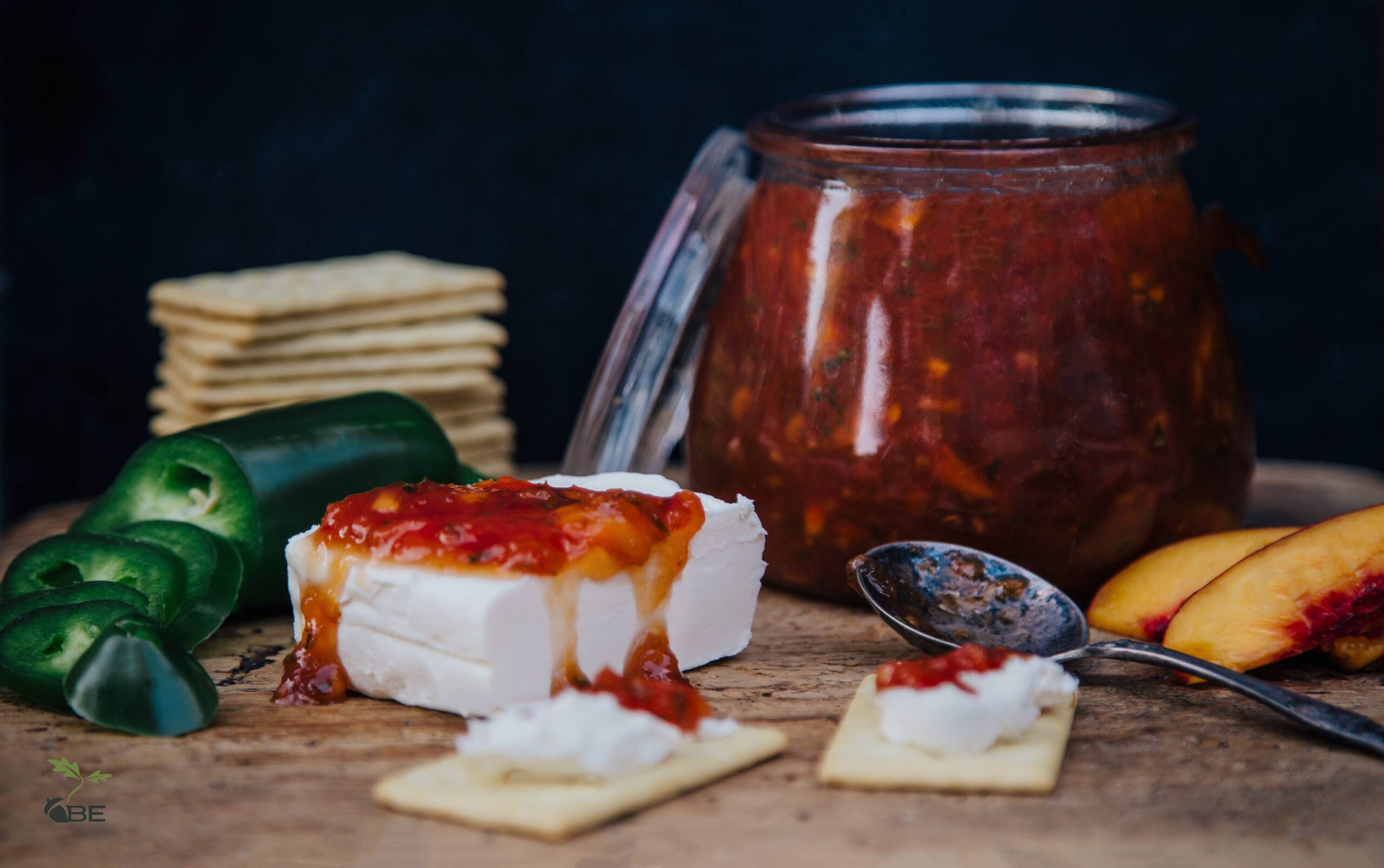
Fresh nectarines lend their sweet tartness to this peppery preserve. Serve as a condiment over cream cheese with crackers for an appetizer or as an alluring sauce over grilled pork chops, chicken, or other meats.
Ingredients
3 pounds nectarines with skins, cleaned, pitted, and roughly sliced
4 cups sugar
4 tablespoons lemon juice
2 teaspoons lemon zest
½ cup finely minced shallot
1 cup finely minced sweet mini peppers
¼ cup finely minced jalapeños
¾ teaspoon salt
½ teaspoon ground ginger
½ teaspoon red pepper flakes
3 ounces liquid pectin
5 tablespoons apple cider vinegar
½ cup chopped fresh cilantro
Canning, or preserving food for shelf storage by sealing it in cans or jars, developed after age-old preservation methods of fermentation, pickling, and smoking. In fact, Napoleon Bonaparte offered a financial prize to anyone who could devise a reliable way to preserve food for his troops. The French inventor Nicholas Appert developed a method of placing food in glass jars, corking them like wine bottles, and adding a protective wax seal to prevent air from entering or escaping. He soon discovered that heating the sealed jars, not just removing air, further prevented spoilage. Not until the mid-1800s, when Louis Pasteur explained how microbes caused food to spoil, did anyone realize the French inventor’s genius. Appert won Napoleon’s contest in 1810. Just two years later, the food industry began to “can” with unbreakable tin cans—a practice that permanently altered how we store and consume food to this day.
Tips on Canning:
- To sterilize canning jars, place them on the dishwasher’s hottest cycle. Do not wash other dishes with the jars to prevent debris from collecting inside them. Use a heat cycle to dry; do not use a towel—even a clean one—as they may introduce bacteria to the inside of the sterilized jar.
- Another method is to boil the open jars upright in a water bath on a fitted rack or a folded towel before filling them with food. Start by filling each jar ⅔ full with water, then place each jar in the pot. Boil for about 10 minutes. Use immediately while jars are hot. Again, do not towel-dry the jars.
- One other method is to wash the jars thoroughly, and, while wet, place them upright in the oven on a baking sheet lined with a kitchen towel. The oven temperature should be set to its lowest setting, but warm enough to heat the jars and sterilize them.
- In addition, make sure to use clean, new lids for each new processing. Flat canning lids should be placed in a small pot of hot water to soften the rubber and help them seal better to the glass rims. Once the lid seals on a processed jar, the center will suck downward with a small popping sound.
- Remember that rings simply hold the lids in place. Do not rely on rings to seal lids. Moreover, rings placed too tightly on lidded jars, or a lack of headspace, can prevent the lids from sealing and even cause them to buckle.
Recipe Created and Stylized by R. Shannon Mock
and Brontë E. Mock

©2018 Be the Beautiful Life All Rights Reserved
Method
To Prepare the Nectarine Pepper Jam:
Place the sliced nectarines in a food processor or blender. Process to make 5½ cups of chunky purée. Place the purée in a large mixing bowl, and stir in the sugar and lemon juice. Permit the mixture to macerate.
In a large skillet over high heat, sauté the minced shallot, sweet mini peppers, and jalapeño until the onions and peppers begin to caramelize. Season the mixture with salt, ground ginger, and red pepper flakes. Reduce the heat to medium. Stir in the macerated nectarine purée, liquid pectin, and apple cider vinegar. Allow the combined ingredients to simmer until the mixture thickens. When thickened, remove the pan of jam from the heat and fold in the chopped cilantro. To serve, let the mixture cool, then spoon over cream cheese and serve on toasts or hearth crackers.
Makes 5 to 6 cups of preserves.
To test for the right thickness of your preserves, try the following methods:
- The COLD PLATE TEST: Place a small plate in the freezer or in ice water for about 15 minutes. Take it out and place a spoonful of hot preserves (away from the heat source). Let it sit for almost a minute. If you move an object such as your finger through the jam on the plate, it should retain its position and even wrinkle slightly without running back together. If it doesn’t hold, then cook for about 5 more minutes and try again. This method is good for small batches of preserves.
- The TEMPERATURE TEST: You may also test the jam’s temperature with a thermometer. Water boils at 212°F at sea level to 1,000 feet. The preserve mixture should reach 8 degrees above the boiling point. In other words, the sea level to 1,000 feet should reach about 220°F to 221°F for the jam to be thick enough. Remember that boiling points change with altitude, so if your thermometer reads 212°F for boiling water, cook the preserves 8°F higher than that. This method is great for large batches of preserves.
- The SPOON TEST: Dip a clean, cold, metal spoon into the mixture. Turn it to its side and raise it up about a foot above the pan. If the jam forms two droplets that flow together and create a sheet that hangs off the spoon’s edge, then it is done.
To Preserve by Chilling:
Ladle the preserves into sterilized hinged jars fitted with rubber rings. When properly sealed and refrigerated between uses, the jam will keep for about 1 to 2 months, maintaining its flavor, color, and quality texture.
To Preserve for Pantry Storage:
Wash, sterilize, and heat four 8-ounce (½ pint) jars. While the jars are still hot, ladle the preserves into each jar, leaving ½ inch of headspace at the top for expansion. Wipe the jar rims clean, then place new self-sealing lids on each jar, followed by screwing on rings until fingertip-tight.
If you do not have a dedicated canning water bath or steamer, use a stockpot or other large pot fitted with a rack or lined with a folded kitchen towel to keep the jars from touching the bottom. Fill the pot with water and bring to a boil. Using canning jar lifters, carefully lower the hot jars into the boiling water. The water should displace and cover the tops of the jars. When the water returns to a rolling boil, process the jars for 10 minutes.
Place a folded-over bath towel on the counter. When processing is complete, use tongs to transfer the finished jars of preserves to the towel, keeping them upright and undisturbed so they can cool and seal. Any jars that do not seal should be reprocessed using new lids.
When stored in a cool environment and kept out of direct light, sealed jars will retain flavor, color, and quality texture for 1 to 2 years. Once opened, refrigerate.