
A fall-inspired twist on the classic chewy & craggy chocolate chip cookie.
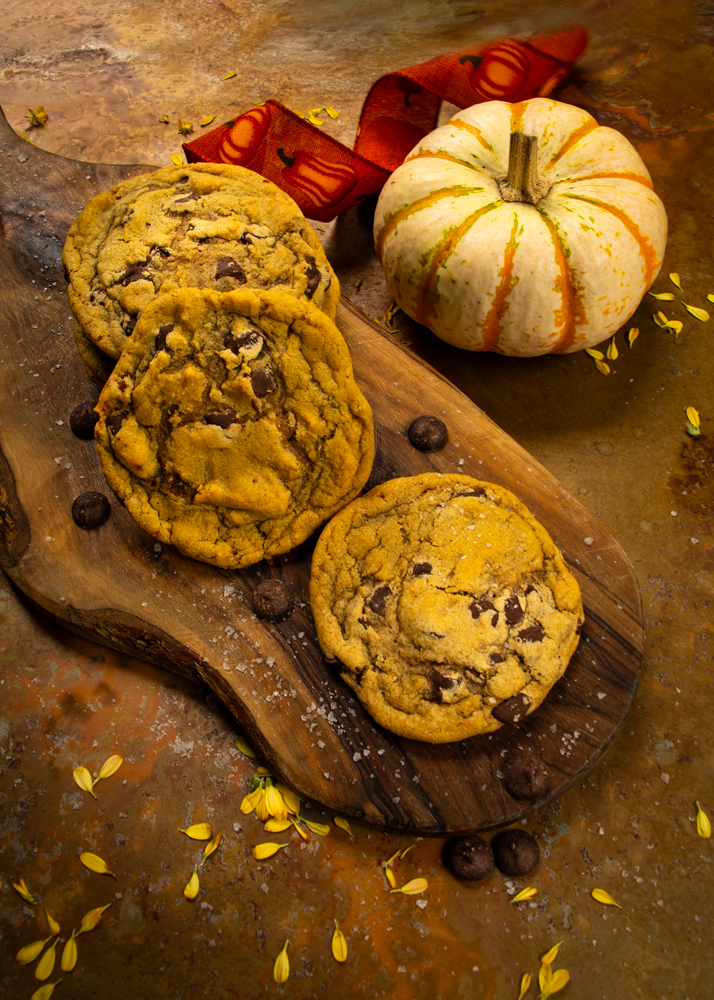
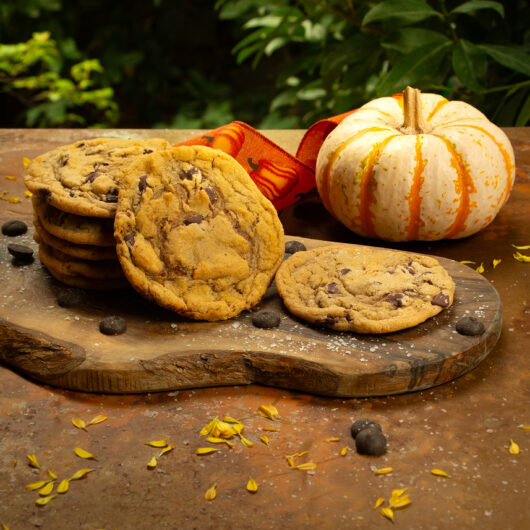
Filled with quintessential fall flavors of pumpkin, warm spices, and chocolate, these delightfully rich, chewy cookies bring a little autumn magic to the classic chocolate chip cookie. These bakery-quality beauties bake up with rustic, craggy tops, lightly crisp edges, an irresistible chewy bite, and melty chocolate goodness. To savor autumn’s simple pleasures, pull out the mulled cider and let the warmth of freshly baked cookies fill your kitchen.
Ingredients
For the Pumpkin Chocolate Chip Cookies:
4 cups (520 grams) unbleached pastry flour*
1 teaspoon (6 grams) baking soda
1 teaspoon (6 grams) salt
2 teaspoons (4 grams) ground Ceylon cinnamon
1 teaspoon (2 grams) freshly grated nutmeg or ½ teaspoon (1 gram) freshly ground green cardamom
1 cup (226 grams) room-temperature butter
4 tablespoons (54 grams) extra-virgin olive oil
2 cups (400 grams) pure granulated cane sugar
1 cup (200 grams) light brown sugar
2 large (100 grams) farm-fresh eggs
2 teaspoons (10 grams) pure vanilla extract
1 cup (230 grams) solid-pack pumpkin purée
2 cups (350 grams) quality semi-sweet chocolate chips
½ cup (50 grams) chopped pecans or walnuts (optional)
*If you do not have pastry flour (8 to 8.5% protein content), then sift 3½ cups (442 grams) unbleached all-purpose flour (11% to 11.5% protein content) and ½ cup plus 2 tablespoons (78 grams) pure cornstarch. Cornstarch will help keep the gluten from turning the cookies into bready cakes.
Nutmeg or Cardamom?
Their incredibly fragrant oils, which enhance baked goods, will clash in this pastry cookie and overpower the butter and olive oil flavors if used together. So choose one or the other. Ceylon cinnamon is more delicate and sweet with citrus undertones than its common Cassia (sharp and woody) counterpart. Ceylon cinnamon and freshly grated nutmeg create classic pumpkin flavor without overpowering it, with warm, nutty yet elegantly subtle notes. Ceylon cinnamon and green cardamom, with its eucalyptus-like notes, produce a more modern bakery combination of bright, sophisticated citrus and herbal undertones that beautifully lift the pumpkin and chocolate richness. Either cinnamon combination works in its own lovely way.
If you love warm spices, save them for the pumpkin pie or the gingerbread cookies. While pumpkin can support a plethora of spices, some warming spices are too strong for delicate desserts and can prevent other ingredients from expressing their purpose. Ground cloves and allspice in pumpkin pie spice create a dominant pungency, and ground ginger adds intense, sharp heat.
Method
To Prepare the Concentrated Pumpkin Purée:
Place the solid-pack pumpkin purée in a small saucepan set over medium heat, stirring continuously with a silicone spatula for approximately 18 to 22 minutes as it cooks. Watch for the heavy steam to dissipate and the purée to reduce as its moisture evaporates, concentrating down to exactly ⅓ cup plus 1 generous teaspoon (100 grams) of dense pumpkin paste. Remove the paste from the stove, and let it cool completely.
To Toast the Optional Chopped Nuts:
If you add raw nuts directly to cookie dough, they act like oil-absorbing sponges and pull olive oil and butter away from doing their important jobs. To counter this, place the chopped nuts in a cold, dry skillet and heat over medium-high heat. Swirl the pan or stir the nuts to keep them moving continuously for about 4 minutes, or until they turn fragrant and release their natural oils. Watch closely, as nuts can cook and burn quickly. Pour the nuts onto a plate or into a bowl and let them cool for about 15 minutes, until room temperature. Adding hot nuts will melt the sugar-butter structure and cause the dough to break down too fast in the oven.
To Prepare the Pumpkin Chocolate Chip Cookie Dough:
Sift the pastry flour, baking soda, salt, cinnamon, cardamom, and nutmeg together into a mixing bowl twice. Set aside.
In the bowl of a stand mixer fitted with a paddle attachment, cream the butter, olive oil, sugar, and light brown sugar on medium speed for 8 minutes, until the mixture turns pale and fluffy. Blend the fresh whole farm eggs, one at a time, into the creamed mixture. Add the vanilla and the cooled concentrated pumpkin paste, beating vigorously until the wet mixture becomes uniformly blended.
Remove the paddle and take the bowl off the stand mixer. Pour in the sifted dry ingredients all at once, folding gently by hand with a wooden spoon or silicone spatula just until the flour hydrates and forms a heavy, sticky dough. Gently fold in the chocolate chips and toasted nuts (if desired).
Cover the dough tightly with plastic wrap and chill for at least 2 hours.
To Bake the Cookies:
About 30 to 45 minutes before baking the cookies, heat the oven to 350°F. For pastry-style cookies, preheat for at least 20 minutes to ensure the oven walls radiate enough heat to create golden edges and force the olive oil to form craggy tops without drying out the cookies. Prepare two half-sheet baking pans with parchment paper. Set aside.
Using a standard #24 cookie scoop (2.5 tablespoons) or weighing each portion to 70 grams, scoop and roll the chilled cookie dough into smooth balls. Place about 8 cookie dough balls on the parchment-lined baking sheets, leaving at least 2 inches of space between each. Bake for 13 to 14 minutes, watching for the edges to turn a deep golden brown and set firmly about 1 inch inward while the centers remain soft and slightly puffed.
Remove the sheet pan from the oven and drop it firmly onto a flat countertop twice to deflate the puffed centers and create the desired craggy top. Set the hot sheet pan on the cooling rack and let the cookies rest on the pan for 5 minutes before transferring them to a wire rack to cool completely.
Makes about 28 to 32 cookies.
High Altitude Adjustments (4,500 feet & above):
For those baking in higher elevations, increase your oven temperature to around 365°F (not quite 375°F).
Add 2 tablespoons (30 grams) whole milk to the wet ingredients to add moisture. Also, reduce the baking soda to 4 grams to prevent rapid expansion that will thin the cookie too much.
Why This Recipe Works
Achieving a chewy pumpkin cookie with a craggy surface requires controlling all moisture levels. By nature, pumpkin introduces a large volume of loose water that typically causes cookies to expand into a cakey, bread-like dome. By evaporating that excess water and creating a concentrated paste, the dry ingredients won’t be overwhelmed and can do their structural work. Using inherently low-protein pastry flour keeps the dough soft and tender. When the butter, olive oil, egg, and pumpkin paste mix, they coat the flour particles in a protective fat layer. This lipid jacket blocks water from activating the gluten proteins. Without a tough gluten web to hold it back, the liquid olive oil forces the cookie to spread flat in the oven, creating a wide horizontal spread, a delicate chewiness, and a beautifully cracked top.
Reducing the pumpkin purée into a concentrated paste prepares it for more uses than these cookies. Standard purée is too wet for pasta fillings, so reduced pumpkin paste combines with ricotta and more to fill tortellini and ravioli. The paste also works better in creamy sauces without breaking down the dairy with its water content, adding its earthiness to mac n cheese, curry, creamy soups, and more. Sourdough breads, sweet rolls, and other artisanal breads need the concentrated paste to keep their unique crumb while taking on the golden-orange tone. And the list goes on!
Recipe Created & Stylized by Robyn J. Mock
Photography by Robyn J. Mock

Leave a Reply